ChiRho
A causal extension to Pyro for probabilistic causal reasoning
ChiRho is an experimental language for causal reasoning and a causal extension to the Pyro probabilistic programming language.

Foundational open-source technology for reasoning under uncertainty.
Basis is building technology that can reason about and operate in environments of the kind of boundless complexity and detail that reality has to offer. To do this, we will focus on how to represent and discover models of phenomena in the world at unprecedented fidelity and scale, incorporating available knowledge of all kinds, be it large or small amounts of data, interactions and experiments, or the wealth of tacit knowledge accumulated by human experts.
One might think that solving complex problems requires complicated technology. We believe the opposite is true: that there are fundamental principles of reasoning that confer an ability to solve problems in general. We aim to leverage ideas from programming languages, compilers and databases to uncover these principles in their most general, reusable, composable forms, and ideas from deep learning to power generic, scalable approximate algorithms for applying them.
We aim to publish technical results regularly at leading venues like ICML, NeurIPS, and PLDI but our primary research medium will be a digital lingua franca of artificial intelligence: a unified, growing body of open-source software that serves as a bidirectional interface with the rest of the world. One example of this is ChiRho, an experimental language for causal reasoning.
Our team’s prior research work has also realized parts of this ambitious vision, developing languages and methods for causal reasoning (Omega and SBI), probabilistic machine learning (Pyro and NumPyro), and computational neuroscience and cognitive science (successor representation learning and Autumn).
Applied problems that guide our research.
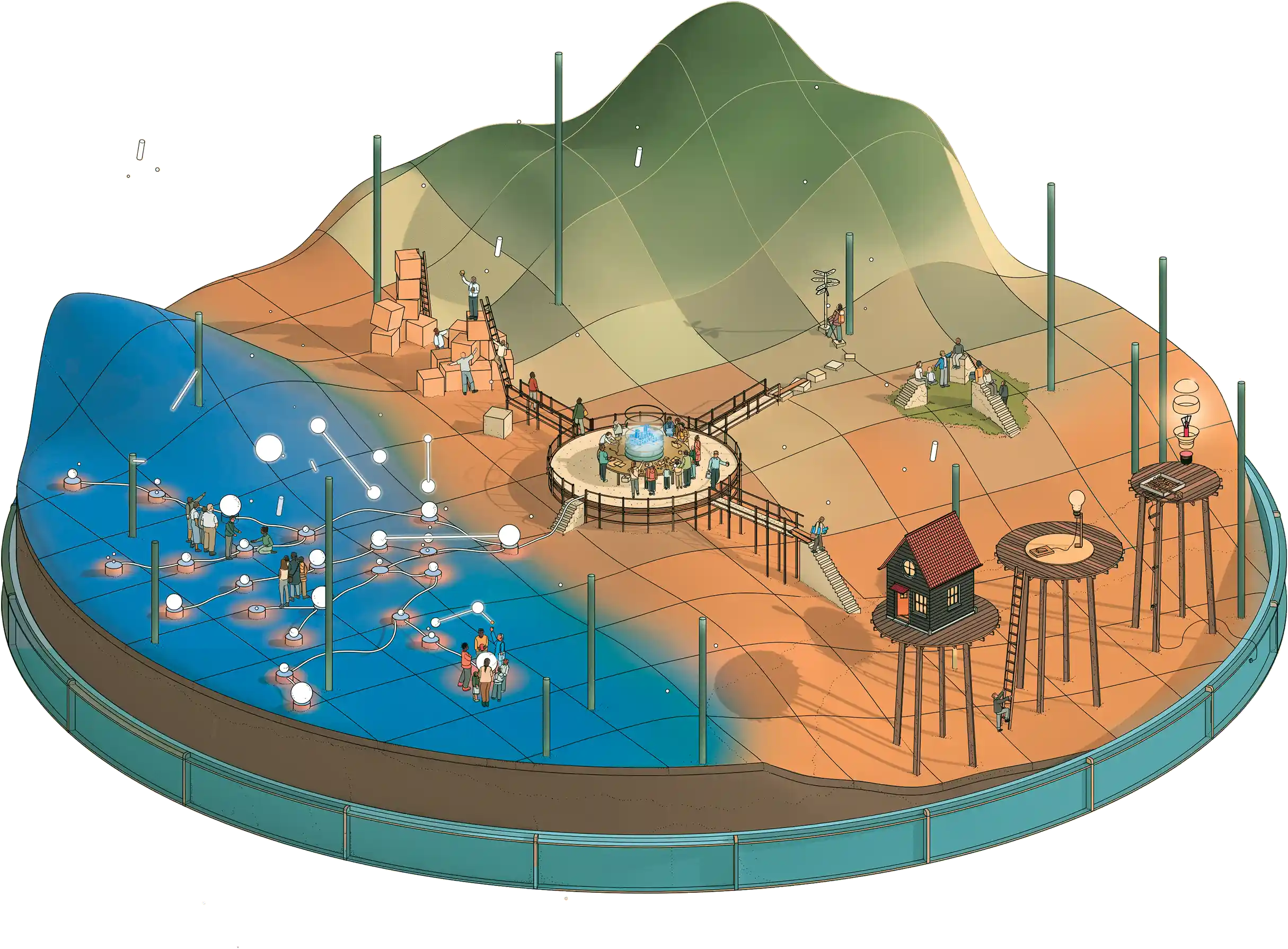
Emulating intuitive scientific discovery
Children resemble professional scientists when they learn about the world around them — they make predictions, revise beliefs, and consolidate their knowledge into theories. Cognitive science suggests that this resemblance is more than skin-deep; children are doing science the same way scientists do. How can we develop machines that engage in this kind of intuitive scientific discovery?
MARA is a long-term effort to build AI systems capable of everyday scientific discovery through active experimentation and abstract reasoning. The project develops foundations for model representation, abstraction, scalable scientific reasoning, and active learning, with the goal of creating systems that can construct and use world models across simulated, digital, and physical domains.
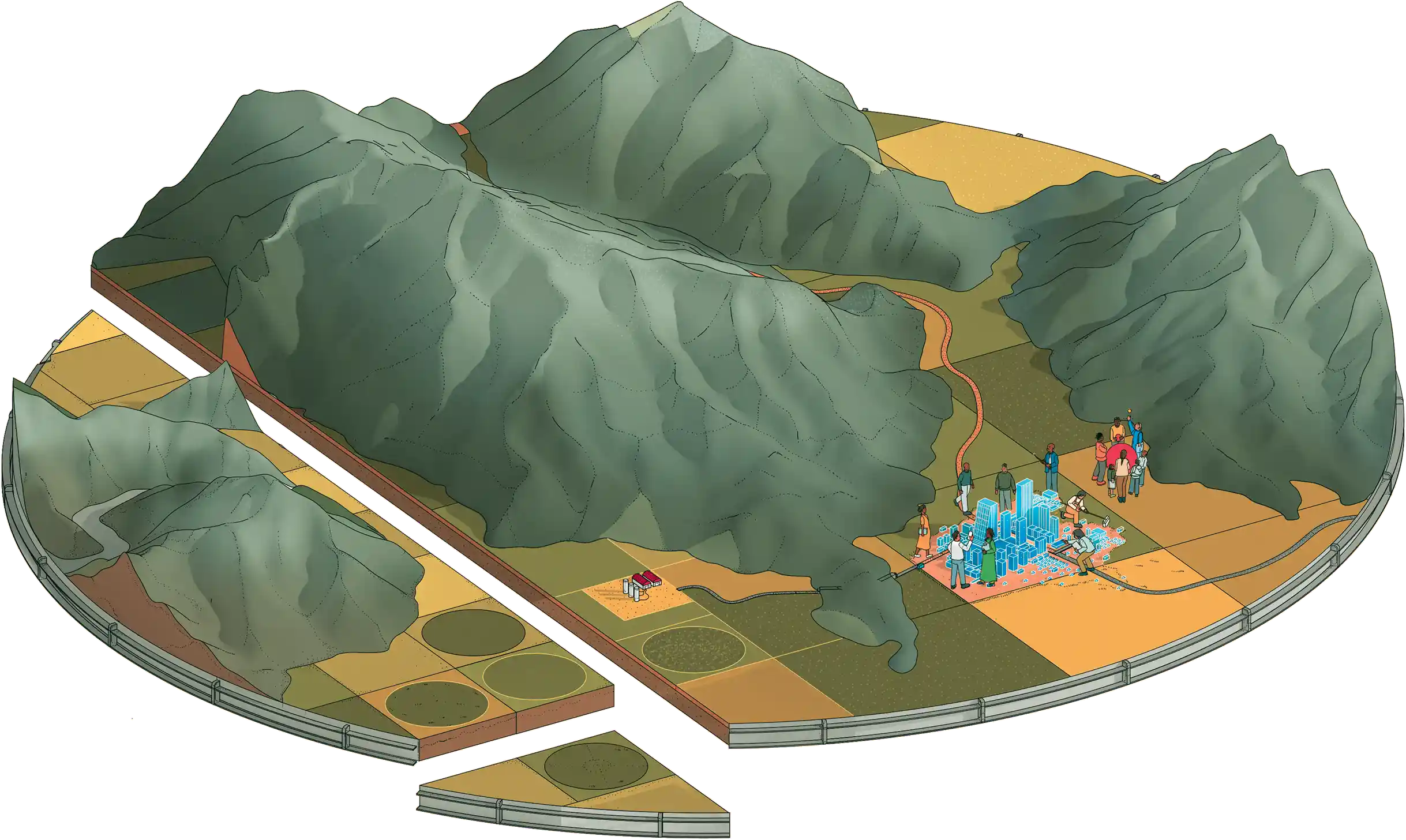
Building a rational, automated robot design agent
While human engineers can create sophisticated robots through intuitive design processes, existing automated approaches to robot design optimization remain limited in their capabilities. Current methods either require massive computational resources or are constrained to simple continuous parameter spaces, making it difficult to explore innovative robot morphologies that could better solve real-world problems.
We are developing R-ADA (Rational Automated Design Agent), an AI system that combines the strengths of human design intuition with computational power. R-ADA uses large language models to control CAD/CAM environments, employs probabilistic programming for reasoning about uncertainty, and leverages Bayesian inference to bridge the simulation-reality gap. This system aims to generate optimal robot designs by breaking down complex design tasks into manageable steps while considering factors like manufacturability, maintenance, and real-world performance.
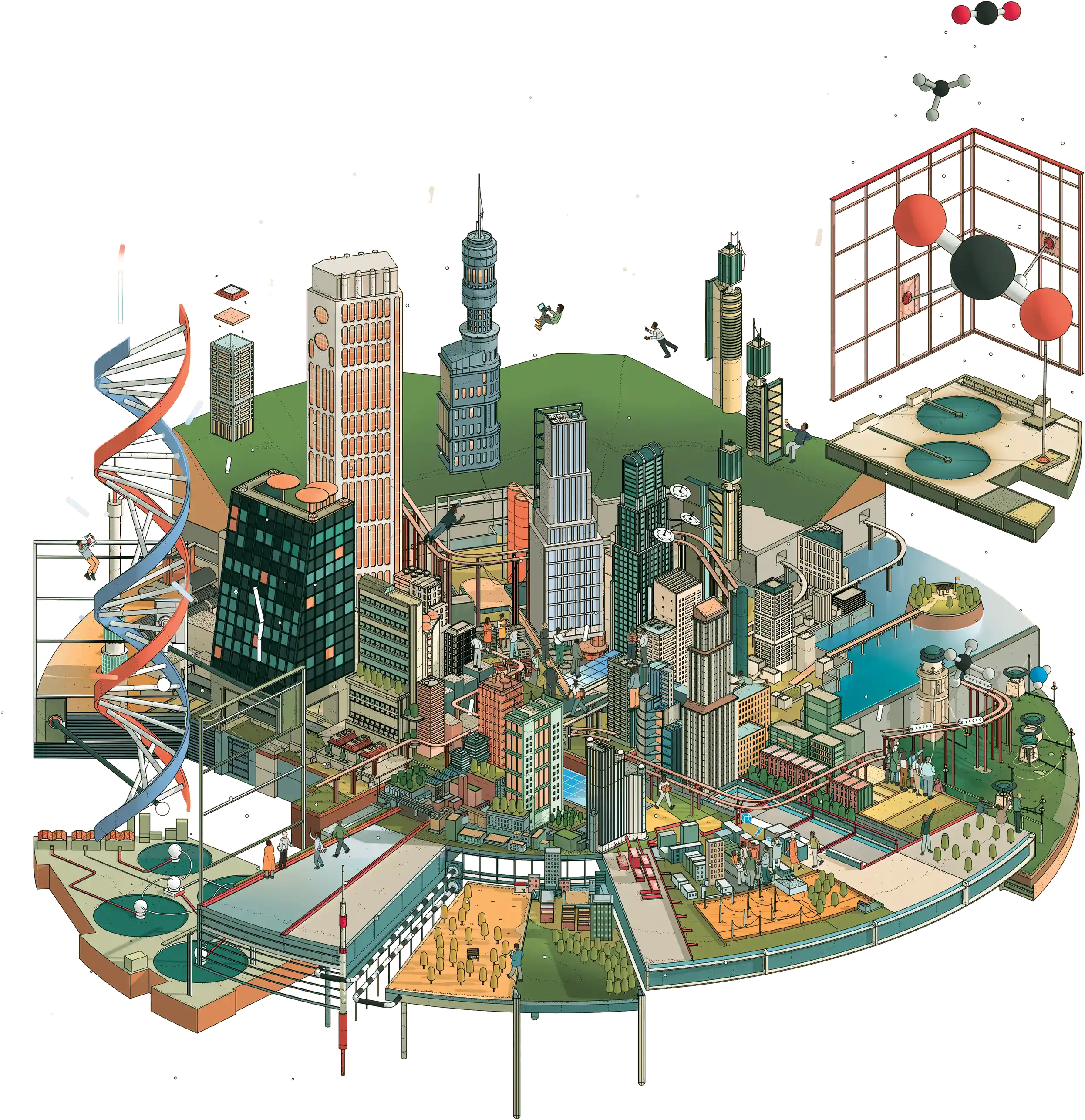
Citymaking through participatory modeling
Residents, community groups, and policymakers all have a stake in making decisions that affect different aspects of the city, but today’s print-centric citymaking processes can be exclusionary. How can technology give agency to a broader set of stakeholders, and help them more effectively communicate their knowledge, values, and questions regarding city policies to each other?
We aim to build a digital representation of the city that incorporates existing knowledge in a participatory manner and allows people to explore different scenarios — that is, a city model. Working with local collaborators, we aim for the model to give more agency to underserved constituencies in citymaking processes like rezoning, street life, and budgeting.
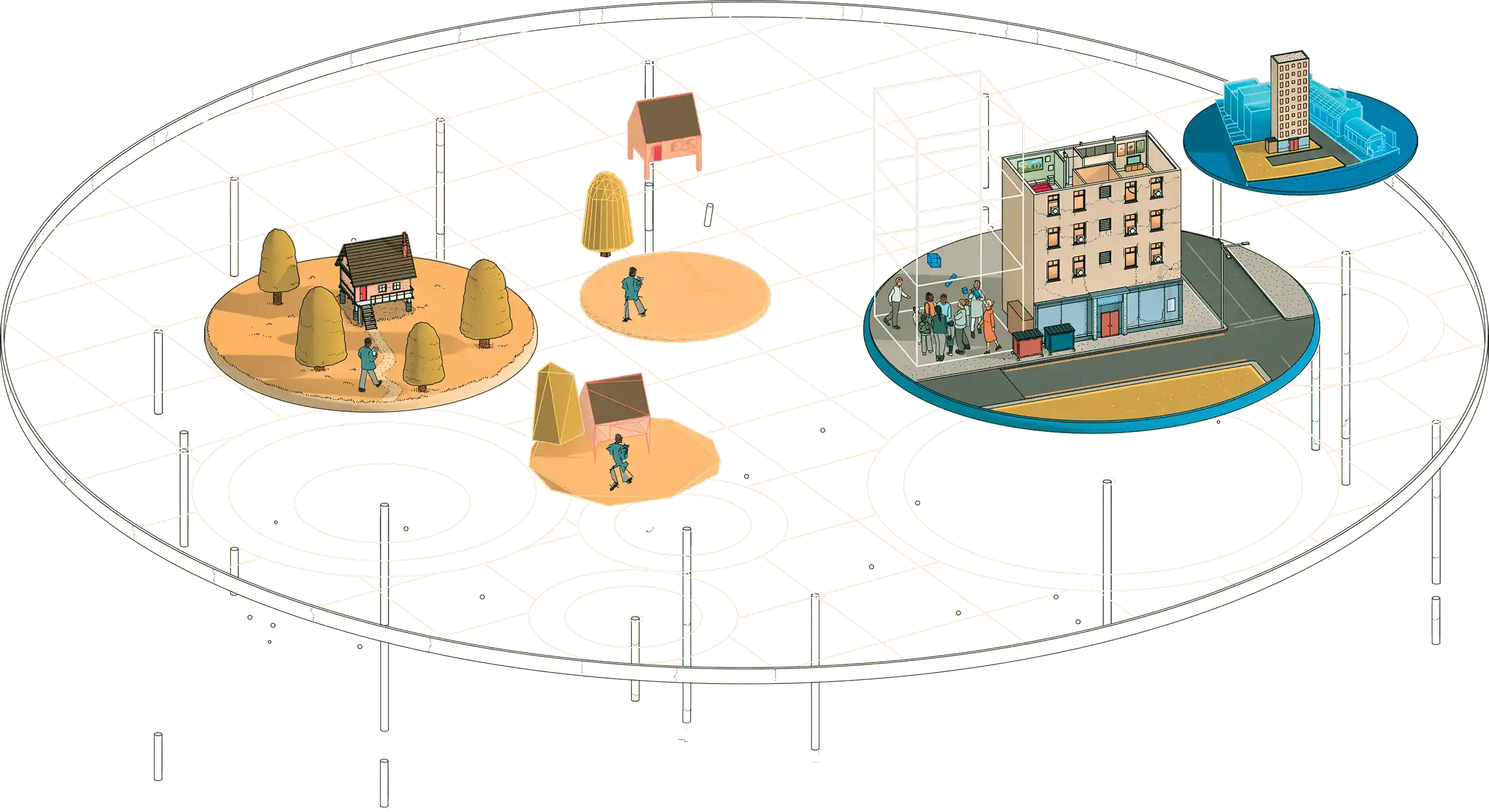
Studying animal social behavior in natural habitats
Animals do not make decisions alone. They forage, communicate, avoid risk, learn, and adapt in social groups embedded in changing environments. Yet most tools for studying animals measure where individuals are, not what social information they use, what rewards they seek, or how group behavior changes under stress. We need methods that can recover hidden structure in social behavior — strategies, preferences, affective states, communication, and environmental context — from messy real-world data.
The Collaborative Intelligent Systems project develops tools for studying social behavior across species and environments. We combine multimodal field recordings, computer vision, probabilistic modeling, simulation, and causal reasoning to reason about latent decision-making strategies. We develop generalizable modeling and inference frameworks applied to different species and environments, with a special focus on urban rodents. We are especially interested in how social behavior reflects cognition, welfare, and adaptation in complex natural and urban environments.
Reusable open-source components that carry core technology across challenge projects.
A causal extension to Pyro for probabilistic causal reasoning
ChiRho is an experimental language for causal reasoning and a causal extension to the Pyro probabilistic programming language.
Algebraic effects and handlers for Python metaprogramming
Effectful is an experimental Python library for metaprogramming with algebraic effects and handlers, and a core component of ChiRho.
Bayesian modeling and inference for dynamical systems in NumPyro
Dynestyx is an extension of NumPyro for first-class support of dynamical systems, with a unified interface to structured inference methods for state-space models.