
The hidden sounds of rats: A new way to hear urban wildlife
Published: November 6, 2026
Article: Elizabeth Gribkoff
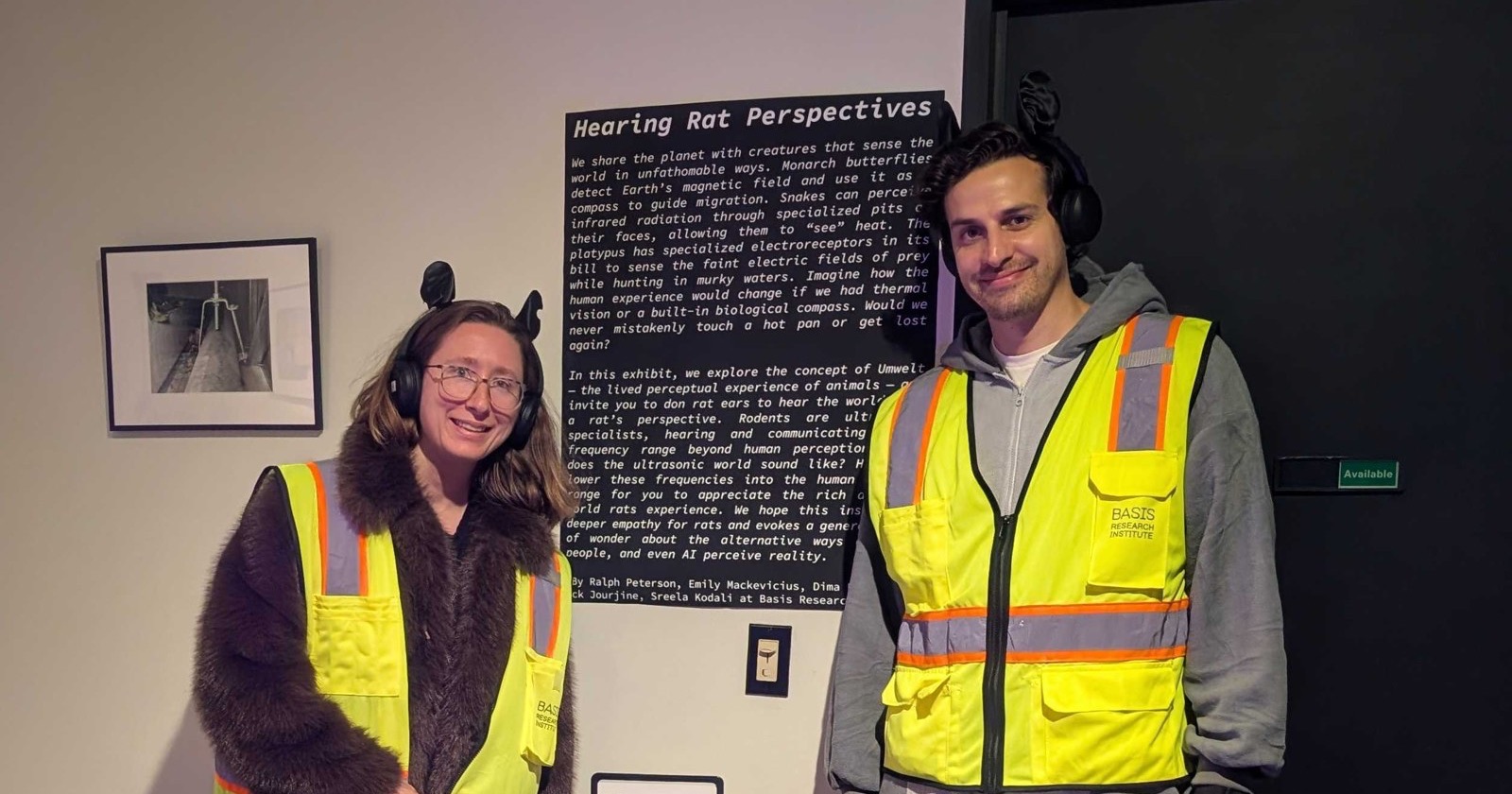
Halloween is a time to don costumes and pretend to be someone — or something — else. With enough face paint and acting chops, we can almost become another creature for a night.
At Basis, we took that transformation a step further this year by creating headphones fitted with 3D-printed rat ears that let listeners tune into sounds normally beyond human hearing. We partnered with Bay Area pest management company Pestec to showcase our rat soundscape at its City Creatures exhibit at San Francisco’s Terra Gallery on October 30, making rats’ ultrasonic vocalizations audible to visitors.
The collaboration began when the Basis team met Luis Agurto Jr., Pestec’s president and CEO, at a conference last year. He later approached the team about doing an installation based on the visuals and sounds present in Basis’ urban rat monitoring data.
“Our goal with the event is to offer a glimpse into the hidden urban ecology all around us. By hearing the world of rats, we hope the public and decision makers will pay closer attention to the interconnectedness of our cityscapes, and to how human behaviors and decisions support these dynamic, highly adaptive animals,” said Agurto. “Ultimately, we want to turn disgust and willful inattention into action: holistic services, investment in infrastructure, and appreciation for the resilience of urban life.”
At the exhibit, visitors compared the rat vocalizations to bird calls and a whining dog and described one call as sounding alarmed. Each pair of headphones played a different selection of recordings from Basis’ research.
“I was delighted to see that listeners could appreciate different emotions in the voices of these rats,” said Basis researcher Ralph Peterson. “Many people think they are just pests and vermin — but hopefully after this experience, they consider the rat with a little more empathy and compassion.”
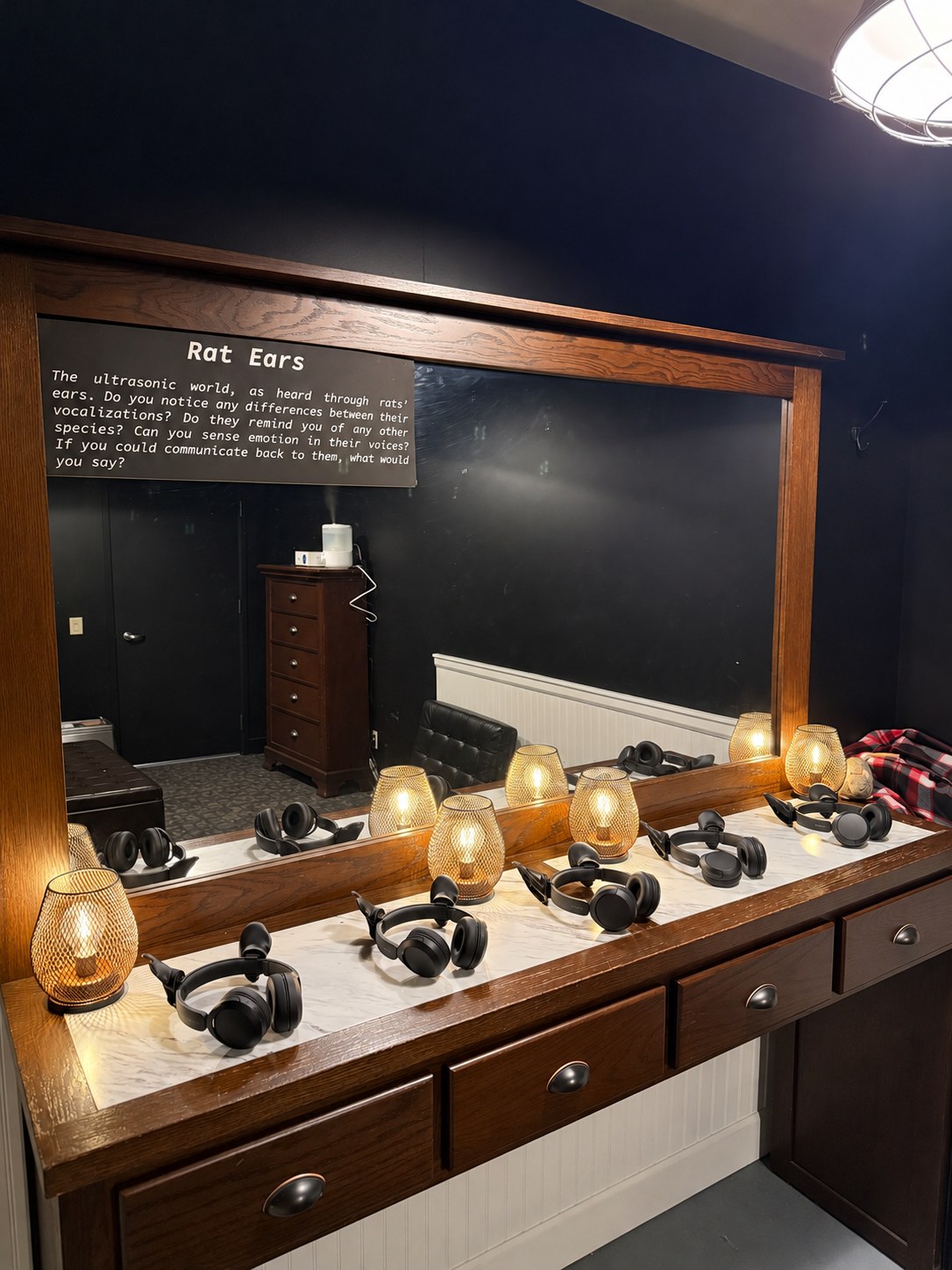
Rat-ear headphones let visitors listen to recordings of ultrasonic rat vocalizations shifted into the human hearing range. Photo: Ralph Peterson/Basis
To make those sounds accessible, Peterson used a pitch-shifting algorithm that lowers the frequencies of ultrasonic rat vocalizations into the human hearing range while preserving their original duration and timing. He and colleague Nick Jourjine selected recordings that demonstrated the rich variation in rat vocalizations.
This exhibit explores the concept of “Umwelt,” or the lived experience of animals. Humans and rats may live on the same city block, but they perceive their surroundings very differently. Making these normally inaudible sounds accessible could inspire deeper empathy for rats and a sense of wonder about the different ways animals, people, and even AI perceive reality.
Basis’ Collaborative Intelligent Systems team brings together neuroscientists, cognitive scientists, mathematicians, engineers, and behavioral ecologists to study animal behavior in the natural world. Understanding how wild rats interact in and move through urban environments could help inform effective, welfare-aware rodent management strategies.
This research also contributes to Basis’ broader work developing AI systems that can reason about the complexity of the real world. This involves broadening the set of sensory signals accessible to AI systems, and modeling the real world in all its beautiful messiness, including high-resolution 3D models of rats moving around dumpsters.
Art provides another way into those questions. Back in 2023, the Basis team also collaborated on an installation for the Venice Biennale, Djali. Artistic collaborations are a powerful part of our research at Basis, connecting us with new perspectives on data, and helping us imagine hypothetical futures we want to create.
“I do think that this has gotten us as researchers to look at the data in a different light that we might not, by default, do as a researcher,” said Basis co-founder Emily Mackevicius. “We do a ton of analysis, but it’s also important to look at the data more slowly, almost at the pace of a rat.”